Whether to hire a drone operator or film it yourself in Ireland comes down mostly to where you need to fly. For an open rural site you control, a registered pilot can manage simple shots. For footage in Dublin, or anywhere near peopleHiring a Drone Operator vs Doing It Yourself
Whether to hire a drone operator or film it yourself in Ireland comes down mostly to where you need to fly. For an open rural site you control, a registered pilot can manage simple shots. For footage in Dublin, or anywhere near people and buildings, you need an operator with the airspace permission and insurance the law requires.
This guide covers what the Irish Aviation Authority actually requires, when doing it yourself works, when it does not, and what each route costs.
What Irish Law Requires Before Any Drone Flies
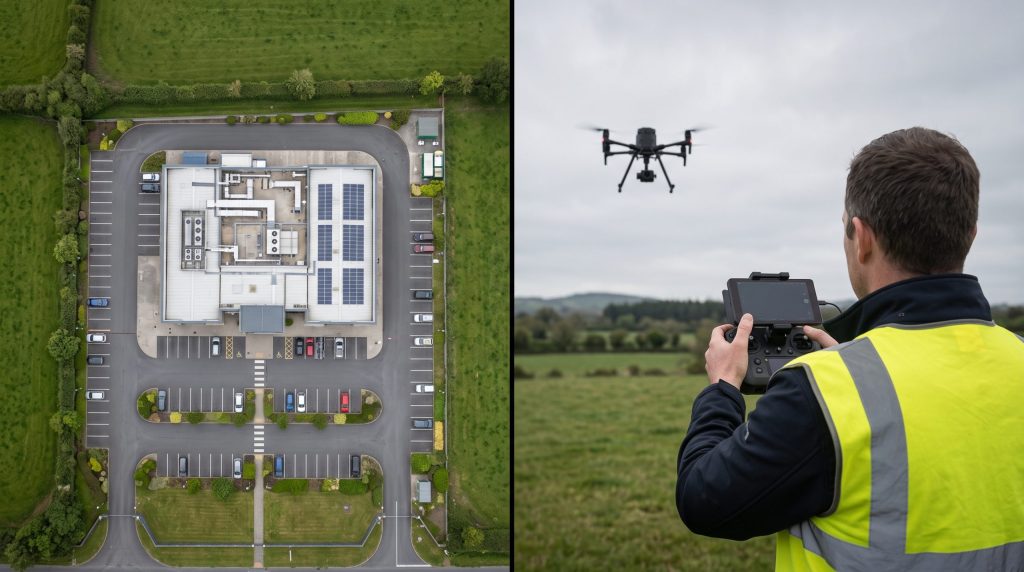
Before a camera drone flies in Ireland, you must register as a drone operator with the Irish Aviation Authority, and for anything over 250g you also need a pilot competency certificate. This applies whether you fly for fun or for a business.
Registration is straightforward. You register yourself as the operator rather than the drone, display the Operator ID on the aircraft, and it lasts two years. Any drone with a camera must be registered even under 250g, which catches nearly every consumer drone sold for filming.
Anything over 250g also needs the online A1/A3 competency certificate before it flies. The training is free and takes about 15 minutes, and the certificate lasts five years.
Those are two separate clocks that people constantly confuse. Registration renews every two years, competency every five, and letting either lapse puts a flight outside the IAA’s rules.
Where You Can Fly, and Why Dublin Changes the Answer
You can fly in the Open Category with no prior authorisation, as long as you stay below 120 metres, keep the drone in sight, and never fly over crowds. Step outside those limits and you need Specific Category authorisation from the IAA before you fly.
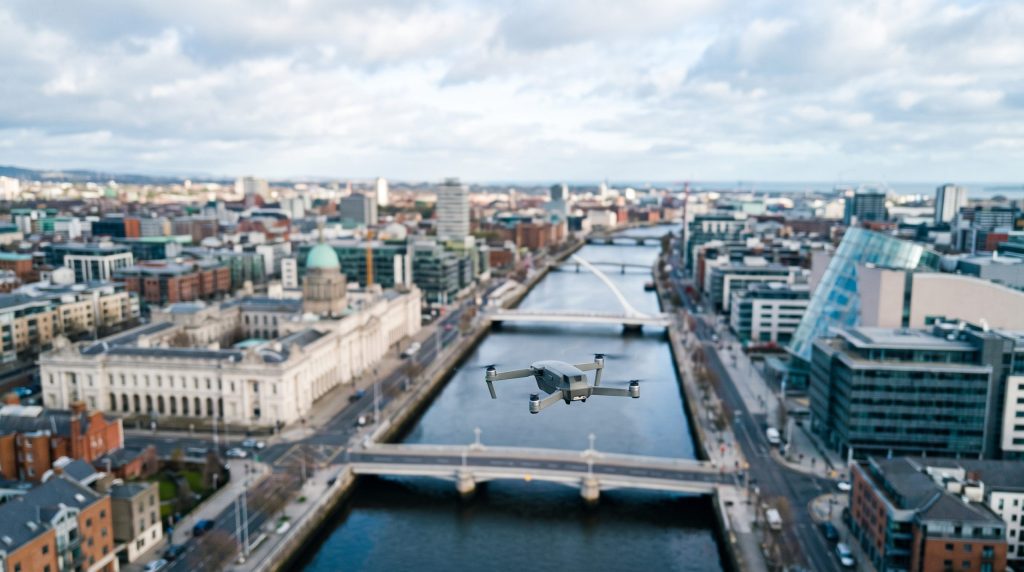
This is where doing it yourself usually falls apart in a city. Much of Dublin sits inside controlled airspace, shaped by Dublin Airport and Casement Aerodrome at Baldonnel, and flying there needs airspace permission no matter how good your footage is.
For that kind of work an operator applies to the IAA for authorisation, coordinates with air traffic control, and works to an approved operations manual. As Dublin City Council points out, the council does not grant drone permissions. Only the IAA does.
So the honest answer to “can I just do it myself” is this: yes, on an open rural site away from people and airports, and usually no, for the Dublin shot most businesses actually want. Check any location on the IAA’s drone zones map before you count on it.
When Filming It Yourself Genuinely Works
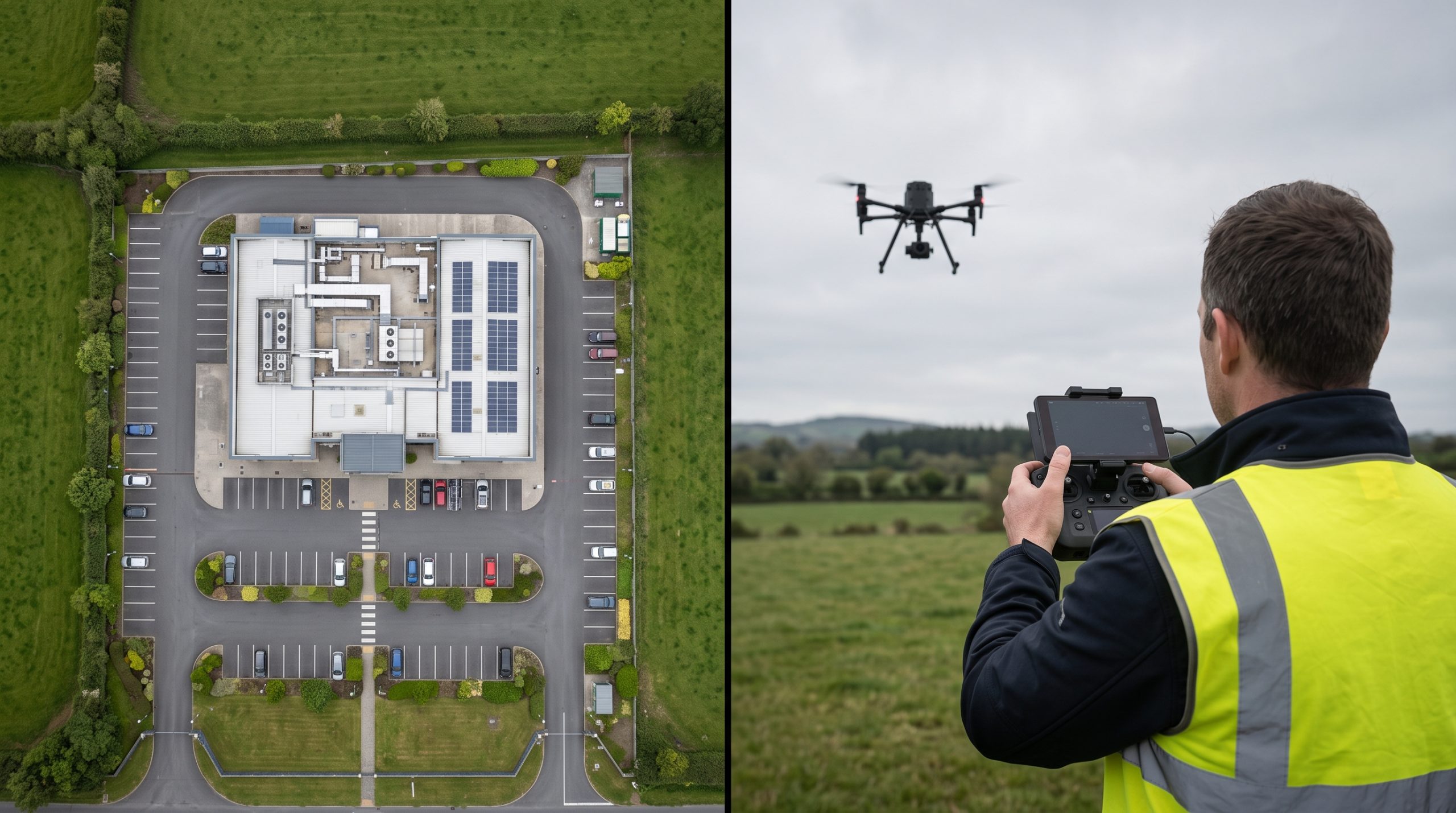
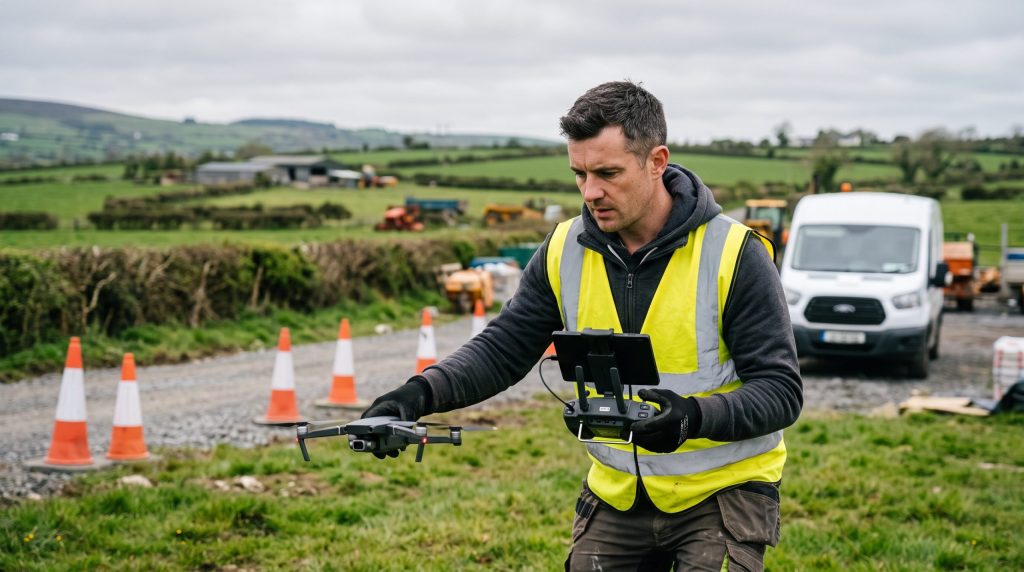
Doing it yourself is a fair call when the whole flight stays inside Open Category limits. Filming your own rural premises, an open field, or a site with no uninvolved people nearby is well within what a registered pilot can do without hiring anyone.
A sub-250g drone makes this easier, since it faces the lightest restrictions, though it still cannot fly over crowds. For a one-off establishing shot on open land you control, the DIY route is genuinely fine.
The limit is proximity and repeatability. The moment you need to fly near a building, a road, a gathering, or anywhere urban, the simple version stops applying, and being honest about which of those describes your shoot is the whole decision.
When Hiring a Certified Operator Pays Off
Hire when the shot needs airspace or proximity that Open Category rules keep you out of. That is most commercial footage: a premises in a town, an event, a construction site, a property near a road, or anything inside Dublin’s controlled airspace.
An established operator already holds the authorisations, files the paperwork, and carries the third-party insurance the IAA requires for commercial flying. A one-off DIY flight for your business leaves all of that to you, and the liability sits with you if something goes wrong.
There is also the deliverable. An operator arrives with the kit, the permissions and the editing to hand back usable footage, rather than raw clips you then have to make work. For a finished business video, that difference shows.
What Each Route Costs
The DIY route costs more upfront than the drone’s price tag suggests, because you are also paying to register, certify and insure. Hiring is a single per-project fee with none of that overhead.
Here is what the legal setup alone costs, before the drone itself, using the IAA’s published fees:
| Requirement | Cost | Validity |
|---|---|---|
| Operator registration | €41 | 2 years |
| A1/A3 online training certificate (drones over 250g) | €51 | 5 years |
| A2 certificate, to fly closer to people | €128 | 5 years |
These are the IAA’s own charges and are VAT exempt. On top of them sits the drone, the time to learn to fly it safely, and insurance for any commercial use.
For a business needing aerial footage once or twice a year, buying and certifying rarely works out cheaper than hiring. For open rural shots you already have the site and clearance for, doing it yourself can be the lower cost.
Where Drone Fits Into a Business Video
Aerial footage is usually one part of a shoot. A few shots from above open a brand film or a property video, while the rest is filmed on the ground.
If you would rather not deal with registration, airspace and permissions, SG Studios offers drone videography in Dublin as part of its wider production work.
On most projects the aerial work sits inside a larger on-location video production, where the drone clips are cut in alongside footage shot on the ground. Having one team handle the filming, the permissions and the edit is simpler than sourcing each separately.
Getting the Decision Right
The choice comes down to where and what you are filming. For a simple shot on open rural land, doing it yourself is reasonable once you have registered and certified. For anything urban, commercial or near people, an authorised operator is the route that gets the shot legally and insured.
If drone footage is part of a larger video you are planning, book a free studio tour and talk through the shoot first.